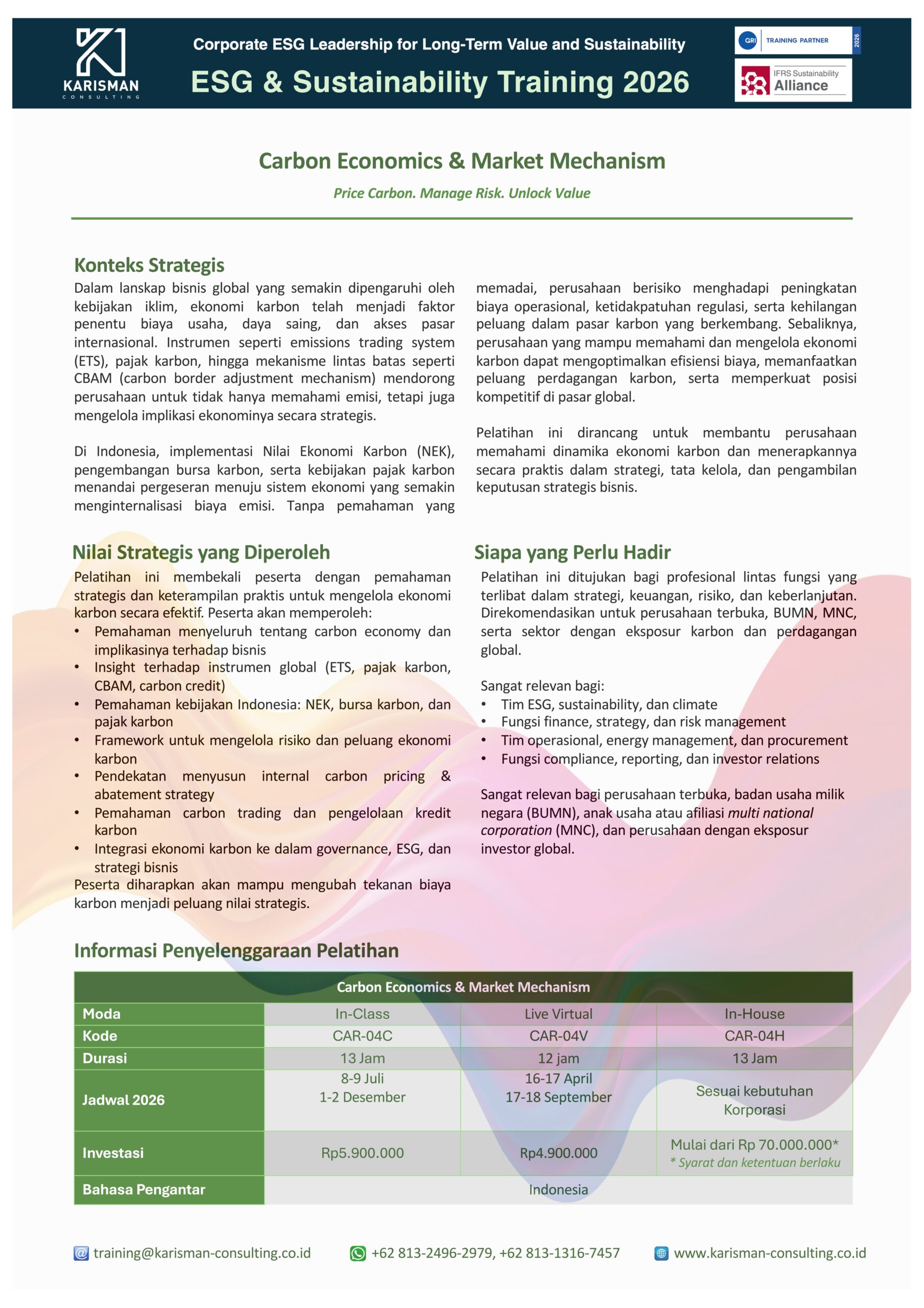






Price Carbon. Manage Risk. Unlock Value.
Program Overview
Globally, a novel signal is subtly influencing business operations: carbon has acquired a price. What was once regarded as an environmental externality is increasingly transforming into a financial variable, impacting margins, investment decisions, and competitive positioning.
From carbon taxes to emissions trading systems, the economics of carbon is redefining value creation and preservation. It traverses supply chains, modifies cost structures, and reshapes capital allocation. Organizations are no longer insulated from these dynamics; they are expected to comprehend how carbon pricing mechanisms translate into tangible financial exposure.
For companies adept at deciphering this signal, carbon transcends its constraints and becomes a lever. A lever for efficiency, innovation, and strategic repositioning in a market progressively moving towards low-carbon performance.
This program is designed to assist organizations in navigating this transition—providing them with the perspective and tools to interpret carbon as an economic variable, manage its implications, and unlock novel sources of value.
Why This Training Matters
- Many organizations encounter carbon pricing as an external pressure—something to comply with, manage, or absorb. Yet without a clear understanding of how these mechanisms work, companies often respond reactively, absorbing costs rather than strategically managing them.
- This reactive approach can lead to missed opportunities. Pricing signals that could inform operational efficiency, procurement decisions, or investment strategy are often overlooked. At the same time, exposure to regulatory changes and market fluctuations remains insufficiently managed.
- Organizations that understand carbon economics take a different path. They integrate carbon into decision-making—anticipating cost impacts, identifying optimization opportunities, and positioning themselves ahead of regulatory and market shifts. In doing so, they transform carbon from a constraint into a strategic advantage, strengthening resilience and competitiveness in an increasingly carbon-constrained economy.
What You Will Gain
- Understand global and Indonesian carbon markets
- Apply internal carbon pricing strategies
- Manage carbon-related financial risks
- Leverage carbon trading mechanisms
- Integrate carbon into business decision-making
Training Schedule 2026
- 16-17 April (Live Virtual)
- 8-9 July (In Class)
- 17-18 September (Live Virtual)
- 1-2 December (In Class)