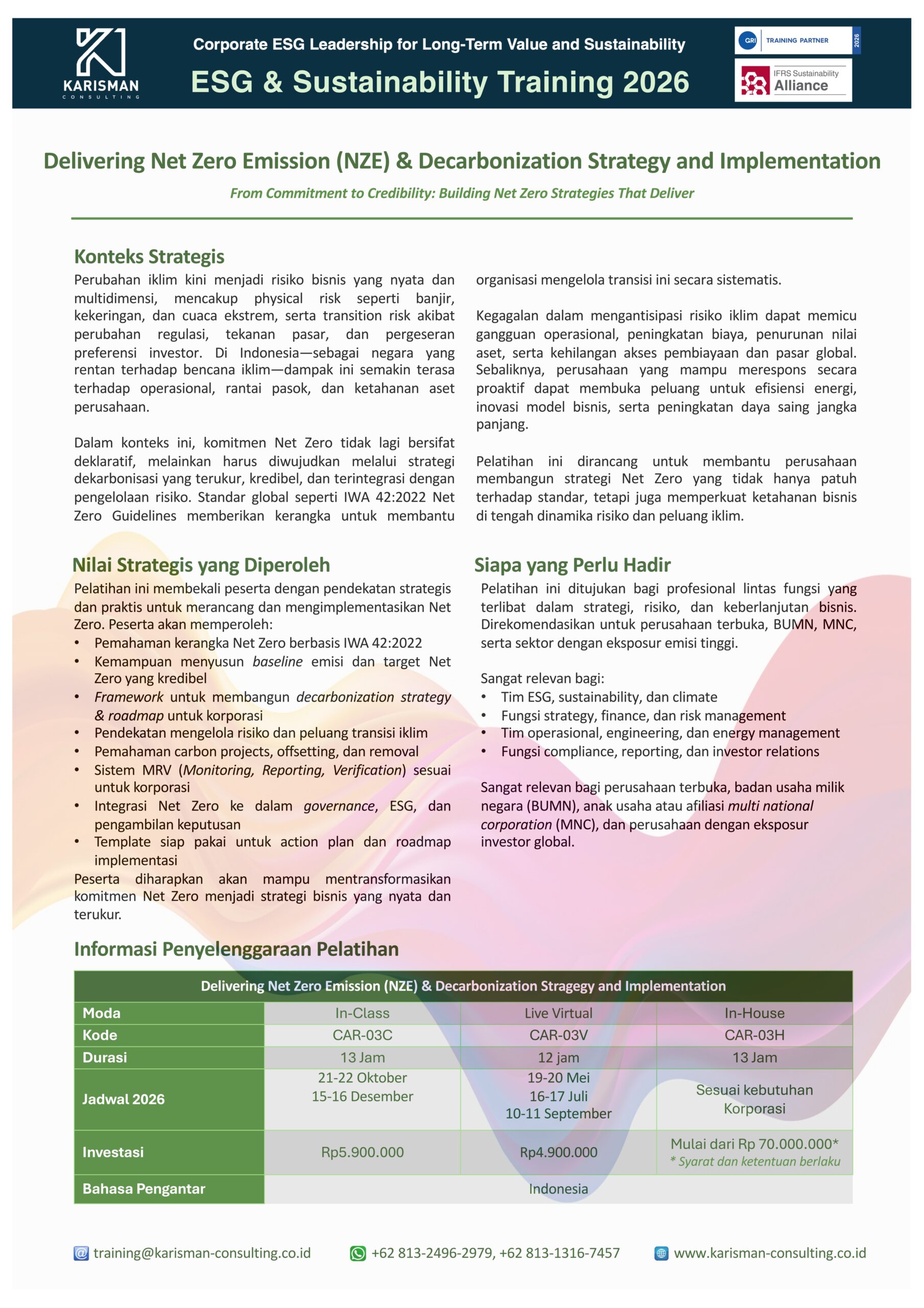






From Commitment to Credibility: Building Net Zero Strategies That Deliver
Program Overview
Across industries and geographies, Net Zero has become a prevalent declaration—printed in reports, announced in forums, and embedded in corporate aspirations. However, behind these commitments lies a more profound question: which companies are genuinely prepared to deliver?
In reality, the path to Net Zero is not a singular trajectory—it is a multifaceted transition that transforms operations, cost structures, and strategic priorities. It necessitates organizations to transcend mere aspiration and confront the practical realities of emissions baselines, reduction pathways, and long-term transformation.
Stakeholders are no longer content with targets alone. They seek clarity—how targets are defined, how progress is measured, and how risks are managed throughout the process. This demands a level of integration where decarbonization is not regarded as a separate initiative, but embedded into financial planning, operational decision-making, and enterprise strategy.
This program is designed to guide organizations through that transition—transforming climate commitments into structured, quantifiable, and value-driven decarbonization strategies that withstand scrutiny.
Why This Training Matters
- Many organizations begin their Net Zero journey with strong intent, but without a clear pathway, that intent often stalls. Initiatives become fragmented, baselines remain unclear, and targets are disconnected from operational realities. Over time, this creates a gap between what is promised and what can be delivered.
- In a landscape where credibility is closely watched, that gap becomes a risk. Stakeholders are increasingly able to distinguish between ambition and execution, between companies that declare and those that demonstrate.
- Structured decarbonization strategies change that trajectory. They provide direction, enabling organizations to translate targets into action, measure progress with confidence, and communicate transparently. More importantly, they position companies not just as participants in the transition, but as leaders, capable of navigating a low-carbon future while strengthening resilience and long-term value creation.
What You Will Gain
- Build Net Zero baselines and targets
- Develop decarbonization roadmaps
- Integrate climate risk into corporate strategy
- Design MRV (monitoring, reporting, verification) systems
- Align with global climate frameworks
Training Schedule 2026
- 19-20 May (Live Virtual)
- 16-17 July (Live Virtual)
- 10-11 September (Live Virtual)
- 21-22 October (In Class)
- 15-16 December (In Class)