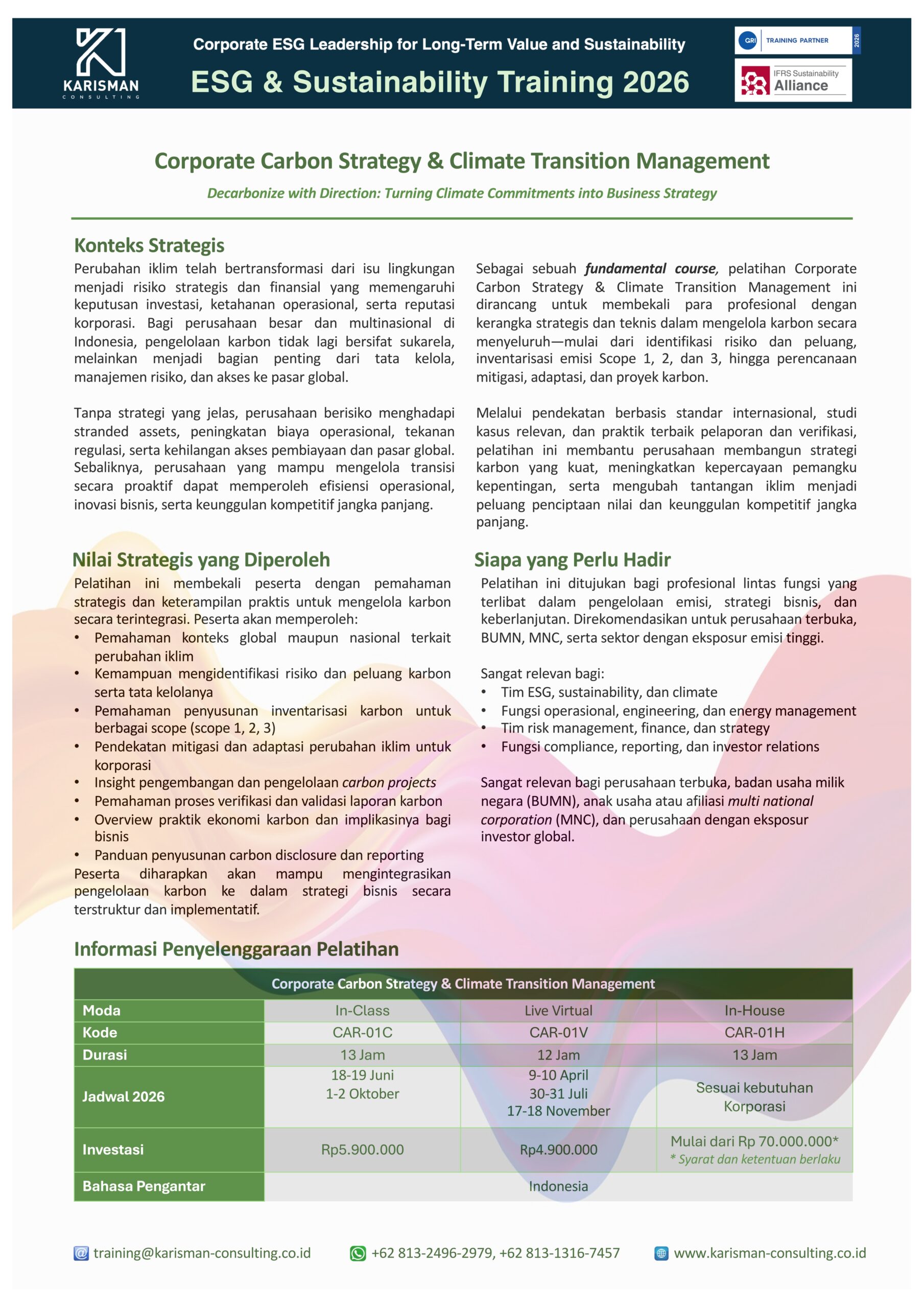





Decarbonize with Direction: Turning Climate Commitments into Business Strategy
Program Overview
Climate is no longer a future scenario; it is a present financial variable. Carbon exposure now shapes cost structures, asset valuation, regulatory compliance, and investor perception. Companies are no longer asked whether they have climate commitments; rather, they are asked whether those commitments are backed by credible, actionable strategies.
In today’s market, climate performance is increasingly linked to financial performance. Investors are assessing transition readiness, regulators are tightening disclosure expectations, and value chains are demanding lower-carbon operations. Organizations that fail to respond risk being left behind, not only operationally but also in access to capital and market positioning.
In this environment, organizations must move beyond fragmented initiatives and build integrated carbon strategies that connect emissions, operations, and financial performance. This program is designed to help companies translate climate ambition into structured execution—aligned with global expectations and business realities.
Why This Training Matters
- Without a structured carbon strategy, organizations face rising compliance costs, transition risks, and declining competitiveness. Disconnected initiatives often result in inefficiencies, inconsistent reporting, and increased exposure to regulatory and investor scrutiny.
- Many companies struggle to translate high-level climate commitments into actionable business strategies—leading to unclear priorities, lack of measurable progress, and misalignment between sustainability goals and financial planning. This gap not only weakens execution, but also undermines credibility in the eyes of stakeholders.
- Companies that act early gain strategic advantage—through efficiency, innovation, and stronger access to capital. More importantly, they position themselves as transition-ready organizations, capable of navigating a low-carbon economy while sustaining long-term value creation.
What You Will Gain
- Develop integrated carbon strategies (Scope 1, 2, 3)
- Identify climate risks and business opportunities.
- Build mitigation and transition pathways.
- Align carbon strategy with ESG and financial performance.
- Strengthen disclosure and reporting readiness.
Training Schedule 2026
- 9-10 April (Live Virtual)
- 18-19 Juni (In-Class)
- 30-31 Juli (Live Virtual)
- 1-2 October (In-Class)
- 17-18 November (Live Virtual)